
For business clearance in the North East, prepare details of the premises, confirm you’re authorised to arrange the work, and list or photograph the items to be removed. There’s no single document pack for every commercial site: the information needed depends on what’s being cleared and the available access. Unclear permission, site details or scope can delay or disrupt arrangements.
It’s understandable to want clarity before a business premises is cleared, especially when equipment, records or fixtures need careful consideration. A written list of what should stay and what should go can help prevent misunderstandings. Include access instructions and any restricted areas so the work is clearly defined.
This guide explains which documents and details can support an application, why a clearance may be refused or cancelled, and what to prepare if the work changes. It also outlines when a local clearance service may help with the practical task of emptying commercial premises.
Key Takeaways
- Identify the type of premises and the items involved so you can describe the clearance scope clearly.
- Find out what to establish about a provider’s waste-carrier status before agreeing collection arrangements.
- Prepare the site details and access information needed to request a quote, then clarify what the quote covers.
- Collection timing depends on practical details such as the volume of items, access and the work required.
- Decide how to handle reusable items, recyclable materials and business records before the clearance begins.
Which commercial premises and business waste can North East clearance companies handle?
Commercial premises include work sites such as offices, shops, cafés, warehouses and workshops. A clearance may cover a whole building, one room or selected items. The right scope depends on what needs removing, the site layout and access restrictions. For example, a shop refit might involve display units and stock, while an office closure could focus on desks, chairs and cabinets.
Business waste means unwanted items generated by business activity, including furniture, shelving, equipment, packaging and surplus stock. Before arranging a clearance, group items by type and mark anything that must remain. A list or photographs can show whether the job involves a few filing cabinets or mixed contents across several rooms.
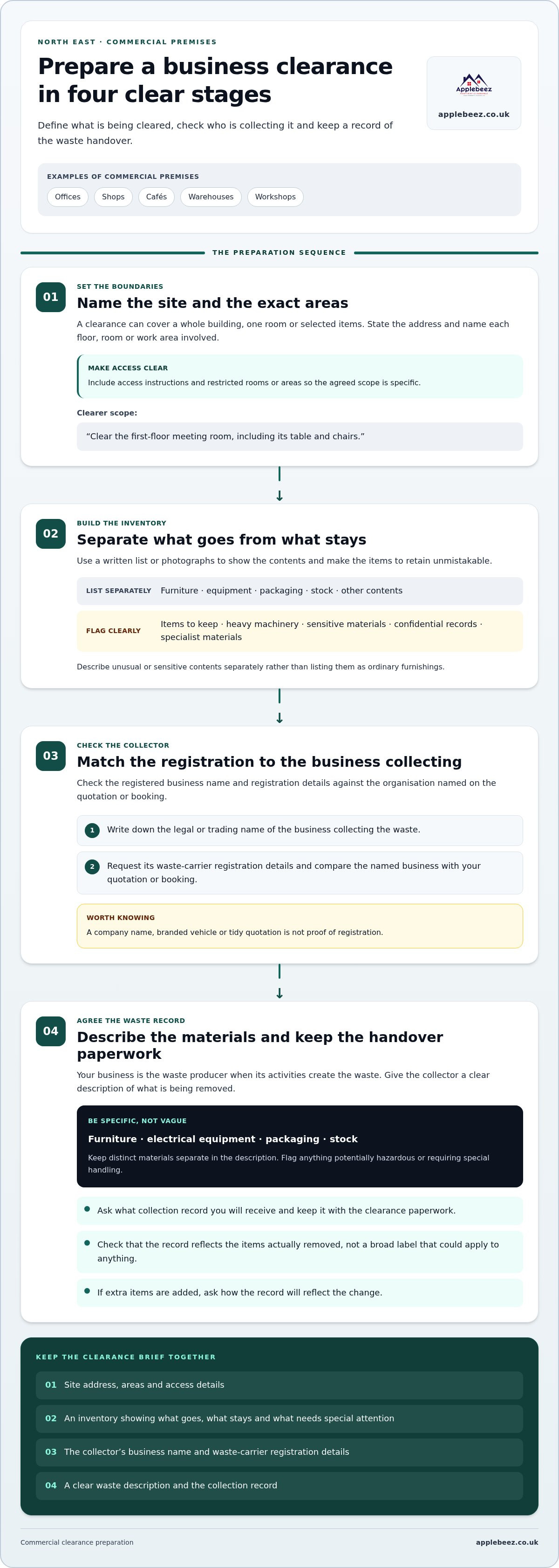
Clearance scope is the agreed description of the areas and items included. Be specific: name the floor, room or work area, then separate items for removal from fixtures and belongings to retain. For instance, “clear the first-floor meeting room, including its table and chairs” is clearer than “empty the office”. Note restricted rooms and access arrangements too.
Examples of commercial premises include a high-street unit, office suite, café kitchen, storage area or light industrial workshop. Contents might include counters, tables, shelving, chairs, non-fixed office equipment and boxed stock. The work depends on the items, their condition, size and location. Describe heavy machinery, sensitive materials and confidential records separately rather than listing them as ordinary furnishings.
Some uses of “clearance” refer to customs procedures, not removing contents from commercial premises. The distinction matters for businesses handling export goods at ports. According to The National Archives, under section 63 of the original Customs and Excise Management Act 1979, a ship loading export goods at a UK port must submit its outward entry before goods are taken aboard. This is a shipping requirement, not a premises-clearance application.
The same Act also concerns officers’ powers over ships. According to The National Archives, an officer may board a ship cleared outwards whilst it is within a UK port or within 3 nautical miles of the UK coast and request its clearance. According to The National Archives, under the original Act, a master who refuses to produce a ship’s clearance or answer an officer’s questions about the ship, cargo and intended voyage is liable on summary conviction to a £25 penalty.
For a premises clearance, prepare a practical inventory before arranging the work:
- Identify the address and the areas involved, such as the shop floor or rear storeroom.
- List furniture, equipment, stock and other contents separately.
- Flag items to keep, restricted access and any specialist materials.
These details help define the work and distinguish a site clearance from customs paperwork involving a vessel, export goods or a port.
Under section 64 of the original Act, a ship or aircraft commencing or touching during a voyage or flight to a destination outside the UK must obtain clearance before departing, unless the Commissioners permit otherwise.
Are North East business clearance providers licensed waste carriers?
Waste-carrier registration records a provider’s status for carrying waste as part of its work. The details relate to the business handling your clearance, so don’t assume all North East providers have the same status. Check the registered business name and registration details against the organisation arranging collection.
A waste producer is the business whose activities create the waste. For example, a shop clearing old shelving produces different waste from an office disposing of broken chairs and unwanted files. Identify your business as the waste producer and describe the items accurately. This helps clarify what the clearance team is being asked to collect and avoids confusion about responsibility.
A waste description is a clear account of the material being removed. List furniture, electrical equipment, packaging, stock and any other distinct items separately. Don’t group everything under “rubbish” if the clearance includes different materials. A warehouse with metal shelving and boxed stock, for example, needs a more useful description than “warehouse contents”. Flag anything potentially hazardous or requiring special handling.
A waste transfer record is paperwork recording a waste handover between businesses. Ask what documentation will be provided for the collection and retain records alongside your clearance paperwork. Check that the description reflects the items actually removed, rather than a broad label that could apply to anything. If the collection changes because additional items are added, ask how the record will reflect that change.
Before agreeing arrangements, use this practical sequence:
- Write down the legal or trading name of the business collecting the waste.
- Request its waste-carrier registration details and compare the named business with your quotation or booking.
- Describe the materials clearly, separating items such as furniture, packaging and electrical equipment.
- Ask what collection record you’ll receive and keep it with the job documents.
These steps help distinguish a registered waste carrier from a business that simply describes itself as a clearance provider. A company name, branded vehicle or tidy quotation isn’t proof of registration. Keep the details together, especially if a landlord, head office or site manager needs a record of who removed the contents.
For a business clearance in the North East, explain who owns the premises, who is arranging the work and which materials are involved. If a contractor’s details differ across its quotation, registration information and collection paperwork, resolve the discrepancy before the waste leaves the site. Clear records make the handover easier to follow. You can also review business clearance support when planning the practical removal of commercial contents.
How can a business arrange a clearance and get a quote in the North East?
A clearance request is a description of the premises, items and work a business wants removed. Start by recording the site address, the areas involved and your preferred timing. For example, a shop closing could request removal of its front counter, display fittings and stockroom contents. Name a contact who can answer questions about access and items to retain.
A scope of work defines what the clearance includes and excludes. List the rooms or areas, then separate items for removal from fixtures and belongings staying behind. “Clear the back office, excluding the printer and wall-mounted shelves” is clearer than “clear the office”. Include known access restrictions, such as a narrow stairwell, loading bay booking or limited vehicle access.
A quote is an estimate for the described work. The price depends on the case and is given after a quote request; relevant factors include the volume and type of contents, access, handling needs and whether cleaning is required. A ground-floor room with a few desks presents different work from a multi-floor office containing mixed furniture and equipment.
Share photographs when they show the volume, layout or awkward items more clearly than a written list. Take a doorway view of each room, then photograph bulky pieces such as a boardroom table or filing cabinets. Don’t hide items behind piles or photograph only one corner. Clear images help explain the work, but should support an accurate description, not replace it.
Before accepting a quote, compare it with your request. Check that it names the relevant areas, identifies items to keep and describes any additional work included. If your list says “furniture only” but the site also contains boxed stock, ask for the scope to be updated. This helps prevent disagreements when the clearance team arrives.
Use this order to prepare your request:
- Identify the premises, site contact and areas requiring clearance.
- List the contents by type, including items to remain and any special handling needs.
- Provide photographs and explain vehicle access, stairs, lifts or loading arrangements.
- Ask for a written quote that matches the requested scope, then review it before agreeing.
A written change records an agreed alteration to the original scope. If you add a storeroom or remove an item from the list, tell Applebeez before work starts and request an updated quote. Adding boxed records to an office furniture clearance, for example, changes what the team must handle. Keep the revised description with the original request.
Businesses arranging a clearance in Sunderland, Newcastle, Stockton-on-Tees, Middlesbrough, Darlington or Durham can make decisions more easily when the request is specific and the quote reflects the premises. Confirm the agreed areas, retained items and access details in writing. This gives the site contact and clearance team the same instructions for the work.
How quickly can North East business clearance companies collect waste
Collection lead time is the period between arranging a clearance and the agreed collection date. For a business clearance in the North East, timing depends on the work required and the agreed arrangements. Removing a few chairs from a ground-floor office involves different planning from clearing several rooms of mixed contents. Give a complete description before discussing dates so the proposed schedule reflects the job.
Clearance volume is the amount of contents to be removed. A small reception area with a desk and chairs is simpler to assess than a warehouse containing shelving, stock and bulky equipment. The quantity, size and type of items affect the work involved. Describe unusual or heavy items separately rather than hiding them among general contents.
Site access describes how the team can reach items and load them for removal. A loading bay with a confirmed booking differs from a town-centre shop with restricted vehicle access. Explain stairs, lifts, security gates, parking arrangements and building access times. If the premises require an escort or sign-in, include the process when arranging the clearance.
Readiness means the site is prepared for the agreed work. Identify items to retain, clear access routes and arrange entry with the landlord or site manager. An office clearance may be delayed if staff are still using the desks or keys are unavailable. A named contact on the day can help resolve practical questions.
Collection slot is the agreed arrival window for the clearance team. Treat it as part of the work plan. Coordinate it with building access, staff departures, contractors and any handover appointment. If a shop must be ready for refurbishment, schedule the clearance before the next contractor needs the space.
To plan the timing, prepare these details before arranging a collection:
- Describe each area and its contents, including bulky or awkward items.
- Explain access, loading arrangements, building rules and the site contact.
- Confirm which items must stay and when the premises will be ready.
- Agree the collection slot and tell the provider promptly about changes.
A revised booking updates the collection arrangements when the original plan changes. Adding a storeroom, losing access to a loading bay or changing the site handover can affect the schedule. Tell Applebeez as soon as plans change, then agree the revised scope and arrival window. This gives the team current instructions and helps avoid an unnecessary failed visit.
A business clearance in Sunderland, Newcastle, Stockton-on-Tees, Middlesbrough, Darlington or Durham is easier to plan when the contents, access arrangements and site deadline are clear. A complete description helps Applebeez assess the work, while a prepared premises helps avoid preventable delays. Keep the agreed collection details with the site contact so everyone follows the same plan.
Can business clearance providers recycle, donate or securely destroy items and documents
Recycling is processing suitable materials so they can be used again. During an office clearance, separate cardboard packaging, metal shelving and electrical equipment rather than mixing them with general contents. Materials need different handling, so label each group clearly. A provider can then assess what fits the agreed collection scope and explain how those items will be handled.
Donation is passing usable items on for someone else to use. Desks, chairs and intact shelving may be suitable for reuse if they’re clean and in working order. Mark these items separately from damaged furniture or equipment that no longer works. Agree in writing whether reuse or donation is included, and what happens if an item cannot be accepted.
Secure destruction is the controlled disposal of documents or storage media containing sensitive information. Paper files, labelled folders, hard drives and USB devices should not be mixed into a general furniture clearance. Identify them before work begins and decide who is responsible for their destruction. A premises clearance alone does not specify how confidential records will be handled.
Sorting is separating contents by their intended outcome before collection. Create distinct groups for items to retain, reuse, recycle and destroy. For example, an office might have usable chairs for donation, broken furniture for disposal, and archived staff files requiring separate handling. Use clear labels or a room-by-room list, then keep valuable records and devices under the business’s control until their handling is agreed.
Make the intended outcome clear in the written scope. “Clear office contents” doesn’t say whether filing cabinets contain records, working monitors should be reused, or cardboard should be separated. Add item descriptions and instructions for each group. If an item’s condition is uncertain, note that rather than assuming it can be reused.
Before collection, work through these practical steps:
- Separate furniture, packaging, equipment, confidential papers and storage devices.
- Label items to retain, donate or recycle so they aren’t mistaken for waste.
- Describe any confidential documents or data-bearing devices in the written scope.
- Agree what the collection includes and how each category will be handled.
A handling record is a written note of the agreed instructions and completed work. Keep the final item list with your clearance paperwork and update it if the contents change. For example, if staff find another box of client files, pause its removal until the handling is agreed. This gives the business a clear record of what left the premises and under which instructions.
If you’re preparing commercial premises for a change, arrange a business clearance with a clear list of items and handling requirements.
Applebeez: House Clearance Service
Applebeez offers a Business Clearance Service for commercial premises that need clearing during a closure, refit or change of use. If the site also needs attention after items are removed, its Cleaning service can support the property’s next stage. For household or estate matters, Applebeez also provides House Clearance Service and Probate Clearance Service.
Before arranging a business clearance, list the areas and contents involved. Note what should remain and identify records or equipment that need separate handling. These details help define the work and keep instructions clear for everyone involved.
If a commercial premises is ready for clearance, contact Applebeez about business clearance.
Make the next step easier to manage
A premises change is also a chance to prepare the space for its next use. Before the clearance begins, decide who in your business will make final decisions about retained items, access and handover. That person can keep decisions moving and help colleagues understand what happens to their work area. If the property is being prepared for new occupants or refurbishment, consider how clearance and cleaning fit into the transition plan.
For a business clearance in the North East, Applebeez offers a Business Clearance Service, alongside House Clearance Service and Cleaning. The right support depends on the property and the work you need done. A clear request gives you a practical starting point without making the change feel bigger than it is.
Take the next step at a pace that suits your plans. Contact Applebeez for clearance support and discuss the premises you’re preparing. With a clear plan in place, you can move towards the next stage with greater confidence.
Frequently Asked Questions
What can a commercial premises clearance cover?
A business clearance in Sunderland, Newcastle, Stockton-on-Tees, Middlesbrough, Darlington or Durham can cover unwanted furniture, IT equipment and sensitive materials from offices, warehouses and other commercial sites. Applebeez provides business clearance, with Cleaning available for premises that need attention after items are removed. Share the contents and site details to request a free, no-obligation quote with no hidden fees.
What should businesses check before hiring a clearance company, including insurance and hidden fees?
Check the provider’s waste-carrier registration details against the business named on the quote or booking. Compare the quote with your requested scope, including areas, items to keep and any additional work, and ask what collection record you’ll receive.


