
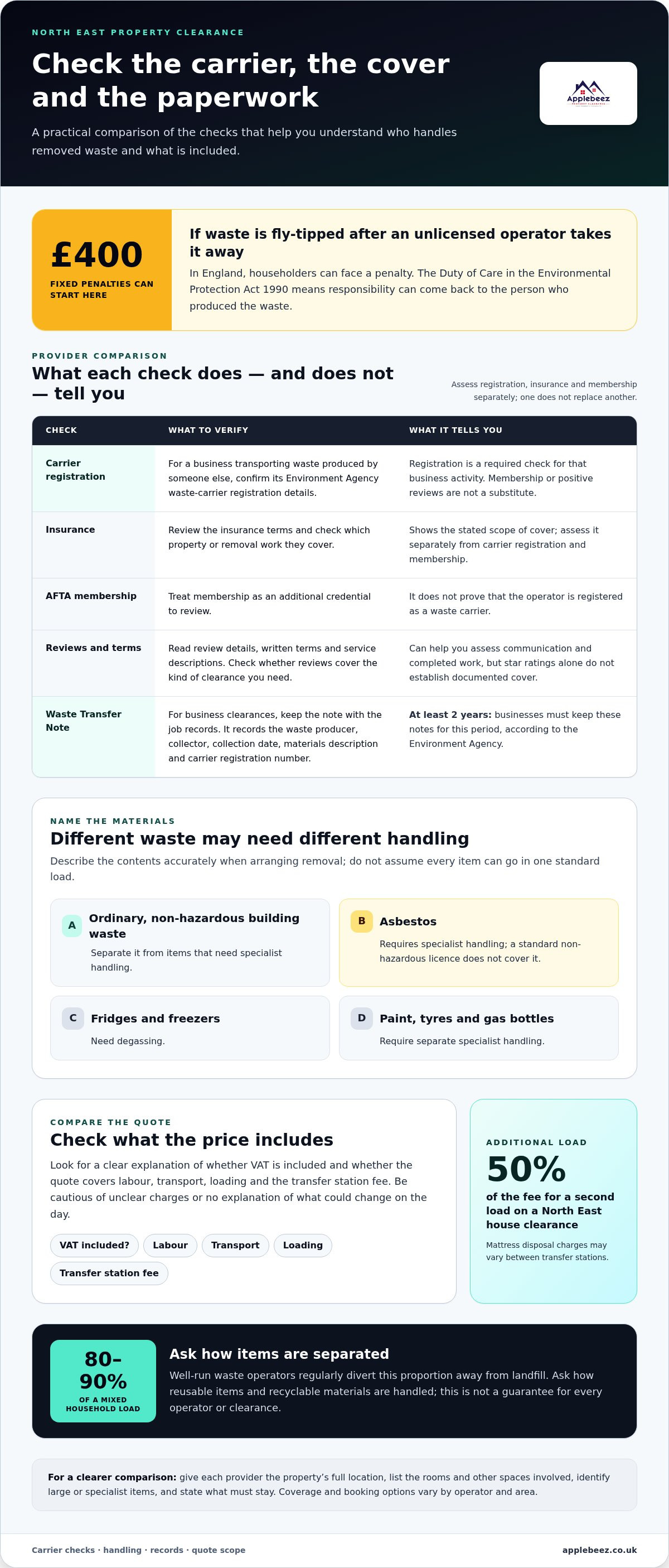
Using a licensed waste carrier matters when arranging property clearance in North East England. Householders in England can face fixed penalties starting at £400 if their waste is fly-tipped after an unlicensed operator takes it away, and the Duty of Care in the Environmental Protection Act 1990 means responsibility can come back to the person who produced the waste. If you're comparing Clearabee alternatives for North East property clearance, confirm who will handle and transport the items removed.
It’s understandable to want a property cleared with as little added stress as possible. The right service should suit the property, the contents and the location.
This guide explains what to look for in a waste carrier, how clearance and cleaning can be planned, and what information helps arrange the work. It also covers locations across the North East, so you can assess your options before taking the next step.
Key Takeaways
- Use a licensed waste carrier: householders in England can face fixed penalties starting at £400 if their waste is fly-tipped after an unlicensed operator takes it away.
- The Duty of Care in the Environmental Protection Act 1990 means responsibility for fly-tipped waste can come back to the person who produced it.
- Businesses must keep Waste Transfer Notes for at least two years, according to the Environment Agency. These records help document how waste was collected and transferred.
- Before booking, look for a quote that explains whether VAT is included and covers labour, transport, loading and the transfer station fee.
- Check the service area against your property’s location: North East clearance services cover a wide range of towns and villages.
Why use a licensed waste carrier in North East England?
Choosing a licensed waste carrier helps protect your household after a clearance. Using an unlicensed operator can leave householders exposed to penalties if their waste is fly-tipped. The Duty of Care in the Environmental Protection Act 1990 means liability can come back to the person who produced the waste.
Businesses transporting waste produced by someone else must register as waste carriers with the Environment Agency. Whether you’re arranging a clearance in Newcastle, Sunderland or Durham, establish who will carry the removed items and how they will be handled. Responsible disposal matters after the van leaves, not just while rooms are being emptied.
Yes. North East clearance services can cover probate and bereavement clearances as well as whole-property work. The scope may include rooms, lofts, garages and gardens. List each area and identify anything that must stay so the work is clear from the outset.
Be cautious of quotes with unclear charges or no explanation of what could change on the day. Fly-tipping is another risk, so check that the operator is registered to carry waste and ask how removed items will be handled. A low initial quote alone does not tell you what work or disposal it includes.
For a property in Stockton-on-Tees, Middlesbrough or Darlington, look for services that cover the specific town or village, not just the wider region. North East England includes varied locations, and the address can affect access and arrangements. Give the full location when comparing clearance options.
Some clearances may be described as free if reusable or saleable contents can offset the work. Whether that applies depends on the items’ condition and resale value, as well as labour and disposal needs. Don’t assume furniture or appliances will cover the cost just because they appear usable.
Include every area in your plans, not just the main rooms. A loft may hold boxes and old furniture, a garage may contain mixed household items, and a garden may have bulky belongings. Listing these spaces helps define the job and reduces the risk of overlooked contents changing the work required.
Mattress disposal charges may vary between transfer stations. A second load for a North East house clearance costs 50% of the fee. The amount and type of waste, including whether another load is needed, can therefore affect the clearance arrangements.
Recycling is another reason to use a responsible carrier. Well-run waste operators regularly divert 80-90% of a mixed household load away from landfill. Ask how reusable items and recyclable materials are separated, particularly when a bereavement makes it important to handle household belongings carefully.
When comparing Clearabee alternatives for North East property clearance, note the property’s location, the spaces involved and any large or specialist items. Compare the work included and how the contents will be handled. This gives you a clearer basis for choosing a suitable service.
Waste clearance services across North East England
Local firms and national operators offer property and waste clearance across the North East. Compare the work covered, records provided and practical protections rather than relying on a company name alone.
Licensing, membership and insurance
In England, businesses transporting waste produced by someone else must register as waste carriers with the Environment Agency. Assess registration, insurance and AFTA membership separately: one does not replace the others. Review the registration details and insurance terms, including what property or removal work they cover. Membership can be an additional credential, but it does not prove carrier registration.
Comparing providers and protections
Which companies operate as alternatives to Clearabee? North East residents can compare local clearance firms with national operators by looking at their stated services and coverage. How do they compare on services and availability? Coverage and booking options vary by operator and area, so review the service scope and booking information for the property’s town. Reviews can help you assess communication and completed work, but read the details rather than relying on star ratings alone.
To compare reviews, insurance and customer protections, look for clear service descriptions, written terms and insurance information. Check whether reviews cover the type of clearance you need, such as household rubbish or business waste. For a firm transporting waste produced by a business, confirm its carrier registration details. These checks help you compare protections without treating membership or positive reviews as a substitute for documented cover.
Waste Transfer Notes provide a record of a waste transfer. According to the Environment Agency, businesses must keep these notes for at least two years. A note records the waste producer, collector, collection date, materials description and carrier registration number. For a business clearance, retain the paperwork with the job records. A clear description of the rubbish transferred makes later record-keeping more useful.
Construction waste needs careful sorting because building work can produce mixed materials. Separate ordinary, non-hazardous waste from items that need specialist handling. Asbestos requires specialist handling that a standard non-hazardous licence does not cover. Fridges and freezers need degassing; paint, tyres and gas bottles also require separate specialist handling. Describe the materials accurately when arranging removal instead of treating all site waste as one load.
Licensed carriers take waste to permitted transfer stations, where materials are sorted for recycling. Residual waste may then go to energy recovery or landfill. For a household, business or construction clearance, compare how each service describes waste handling and what records it provides. For household contents, house clearance services are one relevant option to explore.
Getting a quote and booking a clearance
A useful quote starts with a clear picture of the property and the work required. List the rooms, contents and access details, including stairs, parking, and any garden or outbuilding to be cleared.
Describe what should be removed and what must stay. For example, separate furniture for clearance from documents, keepsakes or appliances the household wants to retain. Note bulky items and materials that need separate handling. These details define the job and reduce confusion on clearance day.
A waste clearance quote should set out labour, transport, loading and the tip or transfer station fee. It should also state whether VAT is included and whether the price is fixed or could change on the day. Read the scope alongside the quoted amount to see exactly what work it covers.
Before accepting, compare each quote against the same property description. A quote for a furnished three-bedroom home may not include a loft, garage or garden unless those areas are specified. Check that the written scope describes the items and spaces on your list rather than relying on a brief verbal estimate.
Booking ahead gives you time to organise access and identify belongings to keep. Most people book their house clearance a week or two ahead. The North East house clearance service says that 48 hours’ notice is usually enough to arrange a clearance, but earlier planning can help when dates are tied to a sale, tenancy or probate timetable.
On the scheduled clearance day, the team aims to arrive at 9am. Keep access clear and mark items that must remain. If a family member cannot attend, a written room-by-room list can help show what should be removed. For a bereavement clearance, this simple preparation can make decisions easier to manage.
A typical three-bedroom house clearance in the North East takes about 3-4 hours. The amount of furniture, how full each room is, stairs and access all affect the work involved. A largely empty home may need less handling than one with a full loft and garage. Treat the typical duration as a planning guide, not a measure for every property.
For an efficient booking, prepare these details before requesting a quote:
- The property location and preferred clearance date.
- The rooms, loft, garage or garden included in the work.
- Bulky items, appliances and anything requiring separate handling.
- Items to keep, plus access or parking arrangements.
Once the scope is clear, keep the written quote and booking details together. They provide a practical reference for the agreed work, arrival time and areas to be cleared.
Cleaning and clearances in neglected properties
A neglected property often needs more than unwanted contents removed. A house with stored furniture, dusty rooms and an unused kitchen, for example, may need clearance followed by cleaning. Plan the tasks in order: decide what stays, remove the agreed items, then clean the exposed rooms.
Walk through the property and make a simple list of each room and area. Include bedrooms, hallways, bathrooms, the kitchen and any outbuildings. Mark belongings to keep, items for removal and areas that need attention. A written list distinguishes a full clearance from cleaning selected rooms, especially when family members are organising a property after bereavement.
Once contents are removed, cleaning can reach surfaces that furniture or boxes previously blocked. A property cleaning service may include vacuuming rooms and cleaning and mopping bathrooms and kitchens. For example, a cleared lounge can be vacuumed after rugs, chairs and stored items are removed. State which rooms need cleaning and the level of work required.
Carpets can affect the order of work. If a room needs new flooring, decide whether lifting the carpet is part of the planned clearance before cleaning begins. Removing furniture first gives access to the floor, while vacuuming afterwards deals with dust and loose debris. Set out the sequence in the written job description.
Use a room-by-room plan instead of asking for “whatever needs doing”. That phrase can leave the scope unclear. List the tasks, such as clearing a spare bedroom, removing boxes from the landing, vacuuming cleared rooms, and cleaning the kitchen and bathroom. Specific instructions help the team understand the work and let you assess the result.
For a property left unattended, record visible items and areas needing attention before work starts. Photos of a packed hallway or a kitchen with accumulated belongings can support your checklist. Keep personal papers, keys and family keepsakes separate from items marked for removal. This is especially useful when an executor is coordinating decisions with relatives who cannot attend.
A sound plan also separates ordinary household contents from materials requiring specialist handling. Fridges and freezers need degassing; paint, tyres, gas bottles and asbestos require separate specialist handling. Identify these items during the initial walk-through instead of mixing them into a general household load. Their handling can affect the order and scope of the clearance.
After the clearance, walk through each listed room and compare it with the agreed scope. Check practical areas such as the kitchen floor, bathroom surfaces and vacuumed rooms. If cleaning is included, specify those tasks in advance. A clear list helps organise the clearance and cleaning, even when the property has been neglected for a long time.
North East England service areas
Service-area detail matters because “North East” can describe a broad region, not a confirmed visit to every address. One North East house-clearance service has pages for 430 towns and villages. That figure shows the scale of local searches, but your property’s exact town, village and postcode still matter when arranging a collection.
Start with the full property address, including its postcode. Add the nearest town or village, especially if the property is outside a main urban area. A home near Newcastle, for example, may have different access or travel considerations from one in a rural village. Clear location details help establish whether the service covers the address.
Check that the area named in a service description matches the property itself, not just a nearby city. Search results may use broad regional wording, while individual service pages name particular places. Compare the address you need cleared with the operator’s stated coverage before arranging access, keys or family attendance.
Location also affects practical arrangements. A narrow street, shared entrance, limited parking or a long distance from the road can change how a team reaches furniture and household items. Note these details alongside the address. For a property in a village outside a larger town, mention any gate, access code or route restriction when discussing the job.
Contents may include reusable furniture as well as items for recycling or disposal. Decide whether relatives want to keep particular pieces or whether usable belongings could be suitable for charity. Separate and label these items before the clearance. This avoids confusion if an executor or someone travelling from outside the area is managing the property.
Use a location checklist before comparing services:
- Write down the complete address and postcode.
- Record the nearest town or village and any rural access directions.
- Describe parking, entrances, stairs and distance to the property.
- List furniture or belongings that must stay, including items set aside for charity.
When comparing Clearabee alternatives for North East property clearance, match each service’s stated coverage to the exact address. Then compare the clearance scope and access arrangements instead of assuming a regional label covers every nearby community. This gives you a practical basis for choosing an option suited to the property’s location.
If you’re arranging a clearance in the North East, discuss your property clearance needs with a local team and share the address and access details.
Applebeez: House Clearance Service
Applebeez provides house clearance across the North East, including properties that need contents removed during a move or after a bereavement. Its Probate Clearance Service supports executors handling an estate, while its Business Clearance Service is for commercial premises. Cleaning is also available when rooms need attention after items have been cleared.
Before arranging a clearance, note the property address, the rooms involved and any belongings that must stay. This gives a clear starting point for discussing the work and the next steps. For a house, business or probate clearance in the region, contact Applebeez about your clearance.
Take the next step towards a clear property
If you’re comparing Clearabee alternatives for North East property clearance, focus on what will make the property ready for its next use. You might be preparing a home for sale, clearing a business space or getting rooms ready for family decisions. Decide on the outcome you need, then describe it clearly when arranging the work.
Applebeez offers house clearance and business clearance, as well as cleaning for properties that need attention after contents are removed. A clear outline of the property and your priorities gives the discussion a practical starting point, whether you’re dealing with one room or a whole building.
When you’re ready to discuss the work, contact Applebeez to discuss your clearance. A manageable next step can help bring order to a demanding task.
Frequently Asked Questions
Do you donate items to charities?
Donations aren’t automatic, so set aside usable belongings you’d like a charity to receive before clearance. Acceptance depends on the charity and the item’s condition. For example, set aside a clean armchair and arrange its donation separately rather than assuming it will be collected with unwanted contents. Keep family keepsakes and saleable items apart too, especially during probate clearance when several people are making decisions.
Do you guarantee to clear the whole property?
A whole-property clearance depends on the rooms and contents included in the agreed work. List each space, such as bedrooms, cupboards, loft, garage and shed, and identify anything that must remain. This prevents “the whole property” from becoming an unclear instruction. For example, if garden furniture is included but the shed is not, write that distinction down before work starts.
What about items I wish to keep?
Set aside belongings to keep before the clearance begins and mark them clearly. A separate room or labelled boxes can help prevent personal papers, photographs, jewellery or family furniture from being mistaken for unwanted contents. If relatives are sharing decisions, make one written list and circulate it to everyone involved. Executors can also identify estate items that need review before removal.
What are typical house clearance prices in North East England, and how are quotes calculated?
There isn’t one typical price for every North East property. Applebeez provides a price after a quote request, based on the job. Factors include the amount and type of contents, rooms involved, access, labour, transport and disposal requirements. A small flat with clear access differs from a furnished house with a full loft, so describe the property and scope accurately.
How do clearance companies in the North East handle reuse, donations, recycling and disposal?
How contents are handled depends on the items and the service arranged. Identify belongings for reuse or donation separately, then make clear which contents are for removal. For example, distinguish a usable dining table from damaged household items and personal papers. Registered carriers take waste to permitted transfer stations, where materials are sorted for recycling; residual waste may go to energy recovery or landfill.
What is the process for arranging a property clearance, getting a quote and preparing the property?
Start with the address, areas to clear and a list of items to retain. Then share access details, such as key arrangements or a shared entrance, and request a quote for that scope. For properties in Sunderland, Newcastle, Stockton-on-Tees, Middlesbrough, Darlington or Durham, include the full postcode. Before the visit, remove valuables and paperwork, and tell everyone involved which belongings must stay.


