

House clearance involves removing agreed belongings from a home, from a few unwanted items to furniture and personal effects throughout the property. What does a house clearance involve, and how do you know what support you need? The answer depends on the property, what should stay and what needs to happen next.
If you’re dealing with a bereavement, preparing a property for new occupants or managing a change in circumstances, it can be difficult to know where to begin. Start by deciding which items need to go and which should remain. The scope can then be shaped around the home and your circumstances.
This guide explains the types of clearance available, what to decide before work starts and how cleaning can help prepare a property after a clearance or tenant departure. It also covers what to expect from a local service in the North East, including Applebeez’s residential clearances in Sunderland, Newcastle, Stockton-on-Tees, Middlesbrough, Darlington and Durham.
Key Takeaways
- A house clearance can cover selected belongings or a whole property, depending on what needs to be removed.
- Decide whether to sort items yourself, arrange professional support for selected belongings or plan a broader clearance.
- List what stays, identify what goes and define the rooms or areas included in the work.
- Agree decisions with household members or representatives before the clearance begins to reduce uncertainty.
- Applebeez provides residential clearance across the North East, with cleaning after a clearance or tenant departure.
House clearance explained: when clearing a home can help
A house clearance removes unwanted household items, furniture and personal effects from a property. It can focus on particular belongings or cover much of the home. The right scope depends on what needs to go and what should remain, not on an assumption that every room must be emptied.
What does house clearance mean?
In practical terms, house clearance is the removal of household contents that are no longer wanted or needed. The work might involve furniture in one room, a selection of bulky items or belongings throughout the property.
It’s different from moving or packing possessions you intend to keep. The aim is to clear agreed items from the home, not transport them to another address or store them for later. It isn’t skip hire either: the work centres on removing the contents identified for clearance.
Being specific about the boundary helps protect items that should stay. Identify any cupboards, rooms or individual belongings that are out of scope before work begins. This is particularly useful when several people have been involved in deciding what should happen to the contents.
When might a household need a clearance?
A change in circumstances can make a house clearance useful. Someone preparing a property for sale may want to remove unwanted furniture and personal effects. A landlord or household may need to clear contents before a change of tenancy or handover. After a move, some belongings may no longer suit the home or the person’s needs. None of these situations automatically calls for a full-property clearance.
Family circumstances can make decisions more involved. After a bereavement, a home may contain everyday belongings alongside items with deep personal meaning. Separate practical items from keepsakes and discuss any uncertain decisions with the people involved. There’s no need to treat everything as unwanted simply because the property is changing hands.
Some households consider estate liquidation and contents sales when managing possessions after a bereavement, downsizing or relocation. This is a separate consideration from arranging the removal of agreed items. If the situation involves an estate, executors may have additional responsibilities, so take the time needed to decide what should happen to personal belongings before arranging their clearance.
Start by asking what the property needs to be ready for next. Is the aim to clear a few items, make space for a new occupant or prepare several rooms for handover? A clear outcome helps define the work without forcing you to decide the fate of every possession at once.
What can a house clearance include, and where does the scope end?
The contents of each home are different, so define a house clearance by the belongings to be removed rather than by a fixed package or room count. One household may need help with a few unwanted pieces of furniture; another may need a wider clearance of household items and personal effects. A clear list of what is included helps set boundaries and protect belongings that should remain.
Partial clearance or full house clearance?
A partial clearance focuses on selected belongings or areas. This might mean furniture in a spare room, unwanted items in the loft or personal effects in a particular part of the home. It can suit a household that is keeping most of its contents but needs help clearing specific items.
A full clearance covers a broader range of household contents across the property. It doesn’t mean every item must automatically be removed: identify belongings to keep before work begins. The difference is the agreed scope, not a standard number of rooms or items. Make a written list of what should go, what should stay and which areas are excluded.
It’s also useful to be clear about what the service does not include. Clearance removes agreed contents from the property; it isn’t house moving or packing, and it doesn’t provide storage for items you want to keep elsewhere. Nor is it skip hire. If you’re arranging waste removal yourself, GOV.UK’s Environment Agency register of waste carriers can help you check a carrier’s registration.
How the property’s intended use shapes the scope
Think about what needs to happen in the home after the contents are removed. Preparing a property for sale may mean clearing items that make rooms difficult to view. A handover or change of tenancy may call for removing belongings left behind. If the home will be reoccupied, the priority could be clearing a particular room or removing furniture that no longer suits the next occupant.
These aims help you decide what is necessary and what can stay. Clearing a few bulky pieces may be enough to make a room usable again; a wider clearance may make more sense if most of the contents are no longer needed. Agree the boundaries with everyone involved before work begins, especially if family members or representatives have different views about personal belongings.
Once the contents are cleared, consider whether the property needs cleaning before sale, handover or reoccupation. Cleaning is a separate next step from deciding what should be removed. Applebeez provides residential house clearance for homes of different sizes, with cleaning after a clearance or tenant departure.
House clearance options: match the support to your situation
Not every change of occupancy calls for a property to be emptied. The right approach depends on how much needs to go, the size and layout of the home, and the time available to organise the work. You might sort belongings yourself and arrange professional help for specific items or areas. If the contents are spread across the property or the task feels difficult to manage, a broader clearance may be more suitable.
Use the comparison below to identify a sensible starting point. It’s a guide, not a set of fixed service levels: the scope can be shaped around the property and the belongings involved.
| Situation | Likely scope | Practical consideration |
|---|---|---|
| A few unwanted items | Selected furniture or household belongings | List what should go and what must stay. |
| Some rooms are being retained | Targeted clearance in agreed areas | Keep the work area distinct from belongings to keep. |
| Contents across much of the home need attention | A broader property clearance | Set clear boundaries for personal effects and items not to remove. |
When a smaller, targeted clearance may be enough
If you’re keeping most of the home’s contents, focus on what’s in the way or no longer needed. That might mean a dining table, an armchair and a few household belongings, or selected items in a room being prepared for use. A smaller scope can suit a home that is only partly being cleared for sale, handover or reoccupation. It keeps decisions focused on the items that need attention now.
When to consider help with a broader clearance
A wider clearance may be worth considering if belongings are spread across several rooms, the home contains substantial contents or you have limited time to organise the task. The scale can feel daunting, particularly when there are many decisions to make. Defining what needs to be removed and what must remain gives the work a clearer shape, without assuming that everything in the property should go.
Before settling on an approach, consider:
- Time: How much time can you set aside to sort belongings and make decisions?
- Property size: Are the items concentrated in one area or spread throughout the home?
- Amount to clear: Is the task a small selection of belongings or a substantial part of the contents?
- Items to retain: Are there personal effects, furniture or household items that should stay in place?
These questions separate the planning from the physical task. You can organise decisions yourself, then arrange professional clearance for the scope that feels difficult to manage. A clear list of rooms and belongings makes the work easier to describe and helps everyone involved understand what is being cleared.
How to prepare for house clearance without making it harder
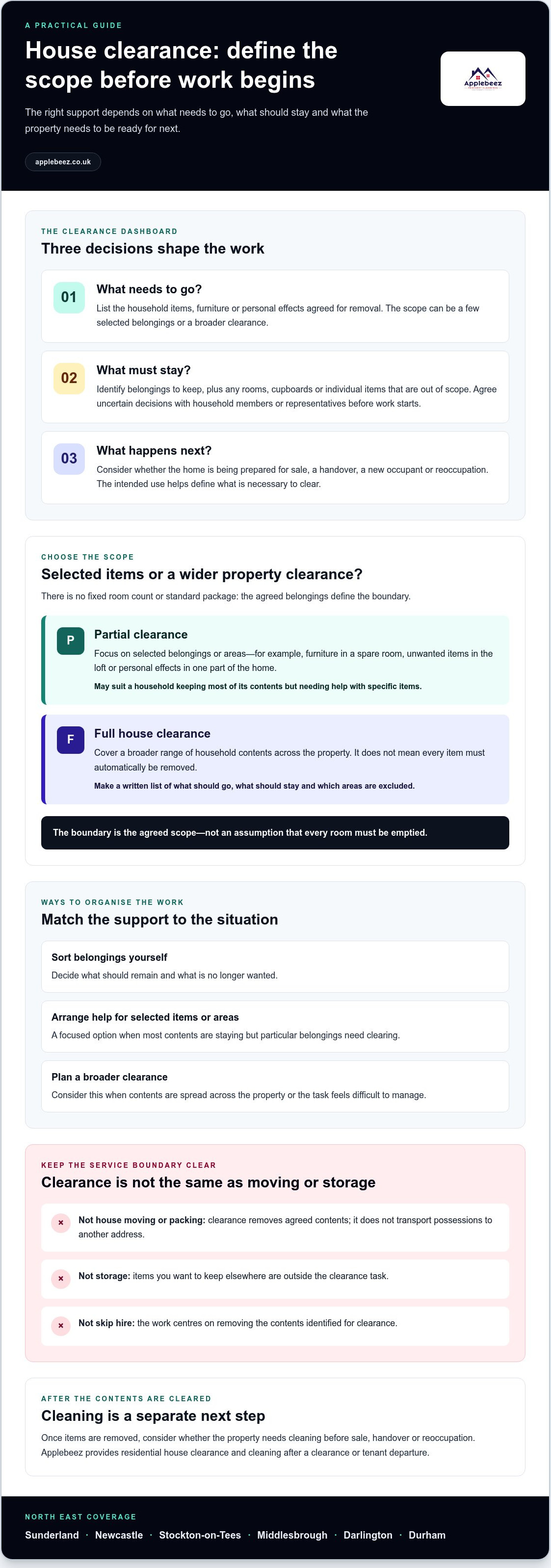
A little preparation can clarify decisions without turning the task into a major project. Start with three questions: what should stay, what needs to go and which parts of the property are included? This gives household members or representatives a shared brief and keeps the clearance focused on the agreed work.
Decide what should stay before anything is cleared
Separate belongings to keep from those intended for removal. Put aside personal papers, keys and any items needed for the property or its next occupant. If an item needs discussion, mark it as undecided rather than treating it as ready to go. The people responsible for valuable or sentimental belongings should agree what happens to them.
Where several people are involved, talk before the clearance begins. A brief conversation can surface family differences while there’s still time to make a considered decision. If one person is acting on behalf of others, make sure everyone understands the agreed items and boundaries. This can help prevent last-minute uncertainty over a photograph, a piece of furniture or a box of papers.
Make the clearance brief clear and practical
Once decisions are made, describe the property, the rooms involved and the general scope. Be specific about exclusions, such as a room that isn’t to be cleared or belongings set aside to remain. Include practical details such as access arrangements and any relevant sale, tenancy or handover deadline. A concise brief is easier to follow than a long list of unresolved decisions.
A simple sequence can keep the preparation manageable:
- Decide what stays. Set aside belongings to keep, including personal papers and keys.
- Identify what goes. Mark agreed items for removal and keep undecided belongings separate.
- Define the work area. Name the rooms or parts of the property included, and note what is out of scope.
You don’t need to make every decision in one sitting. If an item requires family discussion, pause on that item and continue with choices that are already settled. Keep the focus on the agreed scope rather than trying to plan every detail of the clearance day in advance.
With the contents and boundaries clear, you can give a straightforward account of the work required. The Applebeez house clearance service helps with residential clearances across the North East.
House clearance in the North East: local support from Applebeez
Once you’ve decided what needs to be cleared, a local service can help turn that plan into a practical next step. Applebeez provides residential house clearance across the North East for properties of different sizes, removing household items, furniture and personal effects that are no longer needed. The work can be shaped around the property and agreed scope, from a selection of belongings to a wider clearance.
A local house clearance service across the North East
Applebeez serves households in Sunderland, Newcastle, Stockton-on-Tees, Middlesbrough, Darlington and Durham. This gives homeowners, families and representatives in these areas a local option when managing a property transition.
Every home and situation is different. A property may contain a small number of unwanted items, or a broader range of furniture and personal effects may need to be removed. Setting out what should go and what must remain gives the clearance a clear purpose. It also makes it easier to describe the work, particularly if you’re organising the property on someone else’s behalf or working towards a sale or handover.
Fees may be fixed or bespoke, depending on the clearance. Property size alone doesn’t determine the scope or fee. Start with the agreed work: what needs to be removed, and how much of the property is involved?
What happens after the belongings are cleared?
Removing unwanted contents may be one part of getting a property ready for its next use. After a clearance or tenant departure, cleaning can be a useful next step if the home needs attention before handover or reoccupation. Applebeez also provides property cleaning for these circumstances.
Clearance and cleaning address different parts of the transition. First, the belongings identified for removal are cleared; then cleaning can help prepare the property for what comes next. Whether you’re arranging a limited clearance or dealing with a home that needs broader attention, considering both needs can help you plan the work in a sensible order.
For a residential clearance in Sunderland, Newcastle, Stockton-on-Tees, Middlesbrough, Darlington or Durham, discuss your house clearance with Applebeez. Outline the property, the items involved and what needs to happen next.
Take the next step at your own pace
A property transition can feel easier to manage once the next decision is clear. You don’t need every detail settled before taking that step. Start with the outcome you’re working towards, then turn what you know into a simple outline of the help you need.
This gives you a practical way forward without adding pressure to make choices before you’re ready. Whether you’re planning ahead or responding to a change in circumstances, a house clearance can be planned around the needs of the property and the people involved.
To discuss a house clearance in the North East, contact Applebeez with an outline of the property, the contents to clear and what needs to happen next.
Frequently Asked Questions
What is included in a house clearance?
A house clearance includes the belongings agreed for removal, rather than automatically every item in the home. For example, you might include a wardrobe and bedside tables but leave selected furniture in place. Before the work begins, list any exceptions and make sure everyone involved understands the instructions. This sets a practical boundary and helps avoid uncertainty about individual items.
Can I arrange a house clearance for only a few items?
Yes. A clearance can cover just a few items, such as a chair and cabinet in a flat in Sunderland being prepared for a new occupant. Describe each item and where it is in the property, then state clearly what should remain. Applebeez carries out residential clearances for different property sizes, with the agreed scope tailored to the belongings that need to be cleared.
How do I prepare for a house clearance?
Separate settled decisions from anything that still needs discussion. Put aside documents, keys and keepsakes, and mark items or areas that must not be cleared. If relatives or representatives are involved, share the proposed list with them before arranging the work so questions can be resolved calmly. Keep access details and any handover date together in one note. This helps prevent important decisions being left until practical arrangements are under way.
How much does a house clearance cost?
There isn’t one price for every property. The fee depends on the agreed work, including the belongings involved and the scope required. Applebeez may provide a fixed or bespoke fee based on the clearance. To make an enquiry useful, describe the property, the rooms or items involved and any particular requirements. This makes it clearer what the fee relates to than relying on a generic estimate.
What happens to belongings during a house clearance?
Belongings identified for removal are cleared from the property as agreed. Don’t assume an item will be sold, donated or recycled unless that arrangement has been made clear. Before work starts, remove anything you want to keep and set aside items whose ownership or importance is uncertain. This is particularly helpful if several family members have belongings in the home or decisions are being made on someone else’s behalf.
Can I arrange cleaning after a house clearance?
Yes. Applebeez provides property cleaning after a clearance or tenant departure. It can be a useful next step if rooms need attention before a new occupant arrives or the property is being prepared for sale. Cleaning is separate from removing the contents, so explain if you need both services when discussing the work. Describe which parts of the home need attention and what the property will be used for next.